
Cake design is based on a simple principle: the precision of the gesture depends on the quality of the tool. Before choosing between dozens of options, it is essential to understand what distinguishes reliable equipment from unusable gadgets, particularly the compliance of materials with food contact and the actual capacity of each utensil to produce a consistent result.
Food compliance of silicone: what the “food grade” label does not guarantee
The majority of baking and cake design utensils sold online are made of silicone. Molds, spatulas, baking mats: this material dominates the market. A product labeled “food grade” or “food contact” does not provide sufficient guarantee on its own.
For a silicone utensil to be truly suitable for food contact, it must be accompanied by a declaration of conformity specifying the temperature conditions, the types of food intended, and the tests conducted. Soft, translucent silicone or simply labeled as food-grade does not meet this criterion without documentation.
The regulation (EU) 2024/3190 now regulates bisphenol A and other bisphenols in several categories of materials in contact with foodstuffs, including silicones, plastics, inks, and coatings. This regulatory evolution directly affects molds and accessories imported or purchased on marketplaces. Checking for the presence of a conformity document before purchasing helps to eliminate non-traceable products.
Among the equipment on Mademoiselle Caramel, product sheets detail the technical characteristics, making this verification process easier for silicone utensils as well as for other equipment.
Stand mixer and digital scale: prioritizing investments
All competitors list the stand mixer and digital scale as priority purchases. The advice is sound, but the important question is the order in which to invest.
The digital scale, accurate to the gram, is the first purchase to make. Without reliable weighing, no recipe for cookies, cream, or ganache will be reproducible. The cost is low, and the impact on the consistency of results is immediate.
The stand mixer, equipped with a paddle, whisk, and dough hook, comes second. It allows for mixing, whipping, kneading, and emulsifying with a homogeneity that a hand mixer cannot achieve with large volumes. For occasional use, an electric mixer may suffice initially, but the stand mixer quickly becomes limiting when working with heavy doughs or long-whipped meringues.
What can wait
The immersion blender and food processor are useful for emulsifying or mixing certain preparations, but they do not determine the success of a layer cake or a decorated cake with fondant. It is better to allocate the remaining budget to finishing utensils (spatulas, smoother, piping tips) rather than multiplying electrical devices.
Baking and assembly equipment for layer cake
A layer cake requires even layers in height and diameter. The choice of mold directly affects the result.
- Aluminum molds of sufficient height (between 7 and 10 cm) provide consistent thermal conduction and even baking, which limits the dome on the surface.
- Round molds come in several common diameters (15, 20, 25 cm). Having two sizes allows for varying formats without multiplying purchases.
- The cake leveler (or genoise knife) is used to cut layers horizontally. A taut wire gives a cleaner cut than a regular knife, especially on a Molly Cake or a soft Sponge Cake.
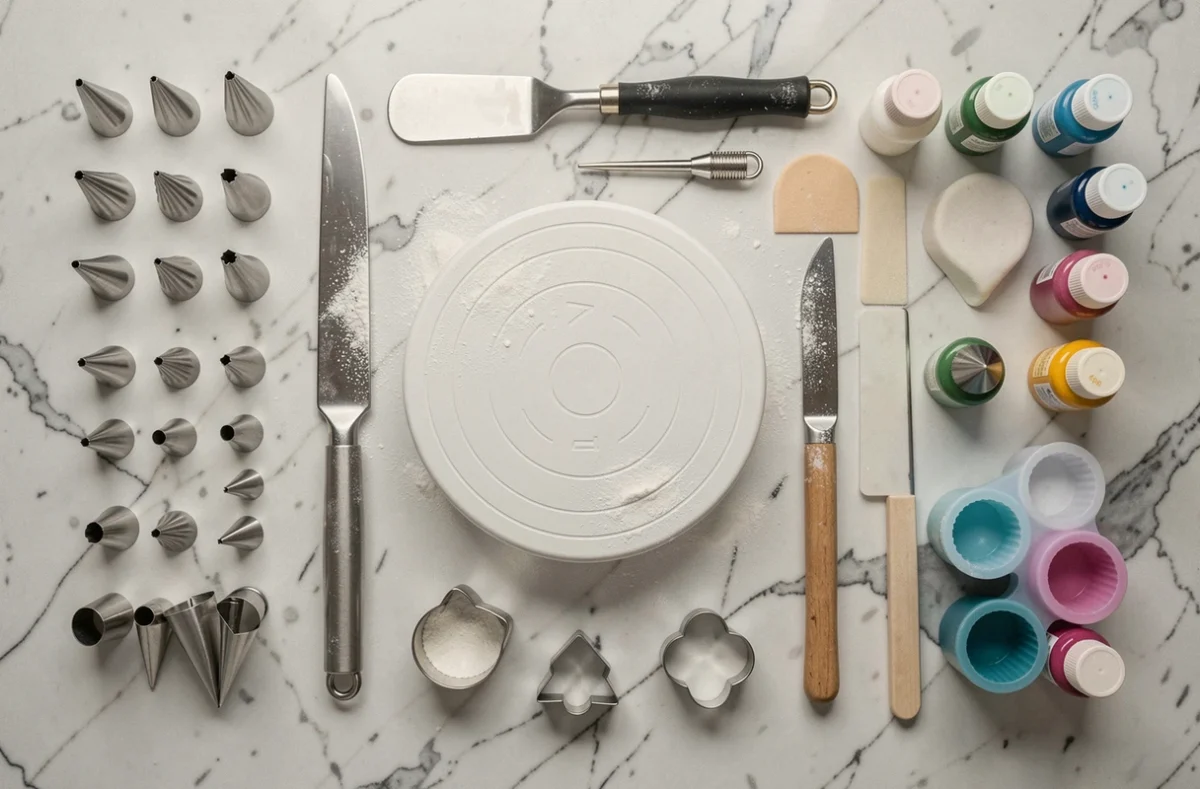
The turntable facilitates frosting and smoothing. Combined with an offset spatula and a smoother, it allows for applying a layer of ganache or buttercream with a consistent thickness. Ganache discs (rigid round plates) serve as supports between layers and ensure the structural stability of the cake.
Piping tips, fondant, and decoration tools in cake design
Decoration is the visible part of cake design, but it is also where unsuitable equipment is most quickly noticed.
Piping tips and bags
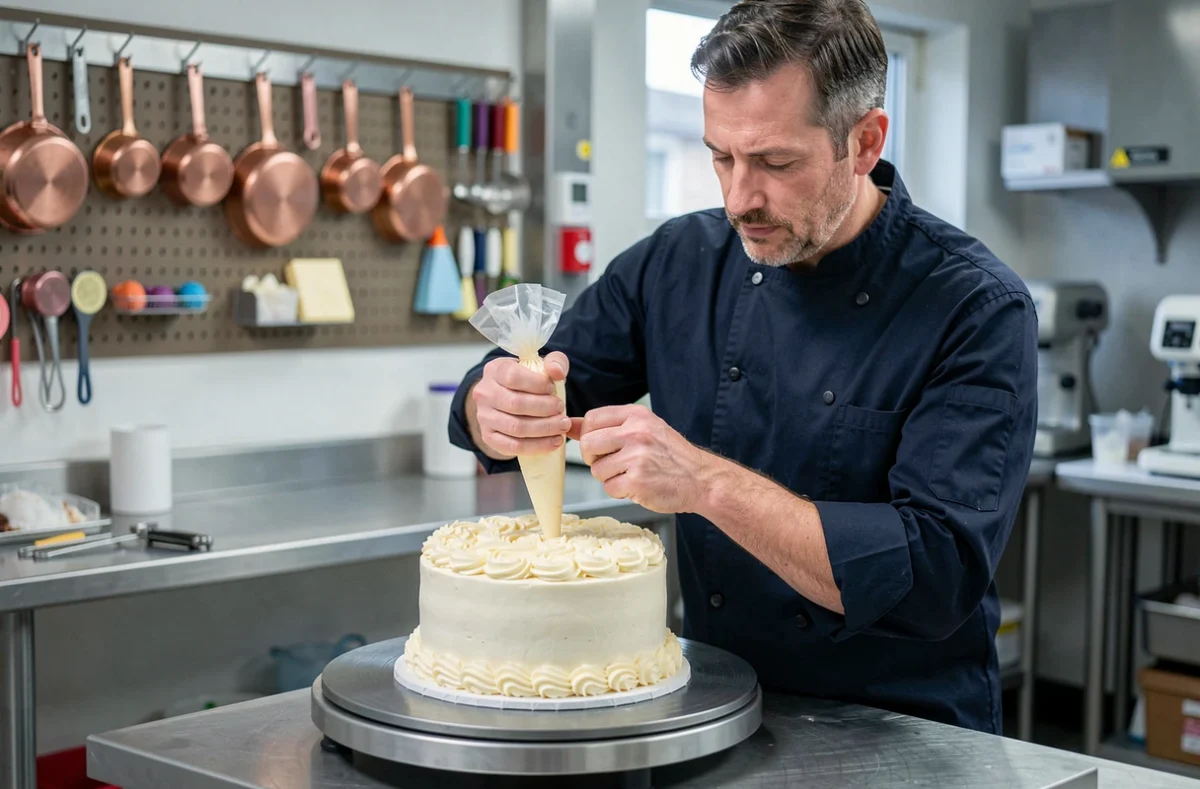
A basic set of piping tips includes a round tip, an open star tip, and a closed star tip. These three shapes cover the majority of cream decorations. Disposable bags are more hygienic than reusable fabric bags, which retain fats in their fibers even after washing.
Fondant and modeling
The smooth rolling pin (made of plastic or silicone, without a textured handle) is the only tool truly suitable for rolling out fondant evenly. A set of modeling tools allows for sculpting details, but three or four shapes are enough to start: ball, cone, blade, and groove tool.
Gel food colorings offer a much higher intensity of shade than liquid colorings, without altering the texture of the dough. A few primary colors (red, blue, yellow) and black allow for achieving almost all shades through mixing.
Second-hand equipment: what to check before buying
A stand mixer, stainless steel table, or professional oven can be purchased second-hand without risk as long as the right criteria are targeted. Points to inspect include the cleanability of surfaces, the absence of porous or heavily scratched areas, the condition of seals, and the availability of spare parts from the manufacturer.
An old but easily cleanable piece of equipment can be more relevant than a new device that is difficult to maintain. A mixer bowl with an intact coating can be sterilized without difficulty. In contrast, a second-hand silicone mold with a surface that shows cracks or a persistent odor should be discarded: food compliance is no longer guaranteed after material degradation.
Buying second-hand allows for concentrating the budget on consumables (colorings, fondant, piping bags) and finishing utensils, which are the areas where quality has the most impact on the final result.