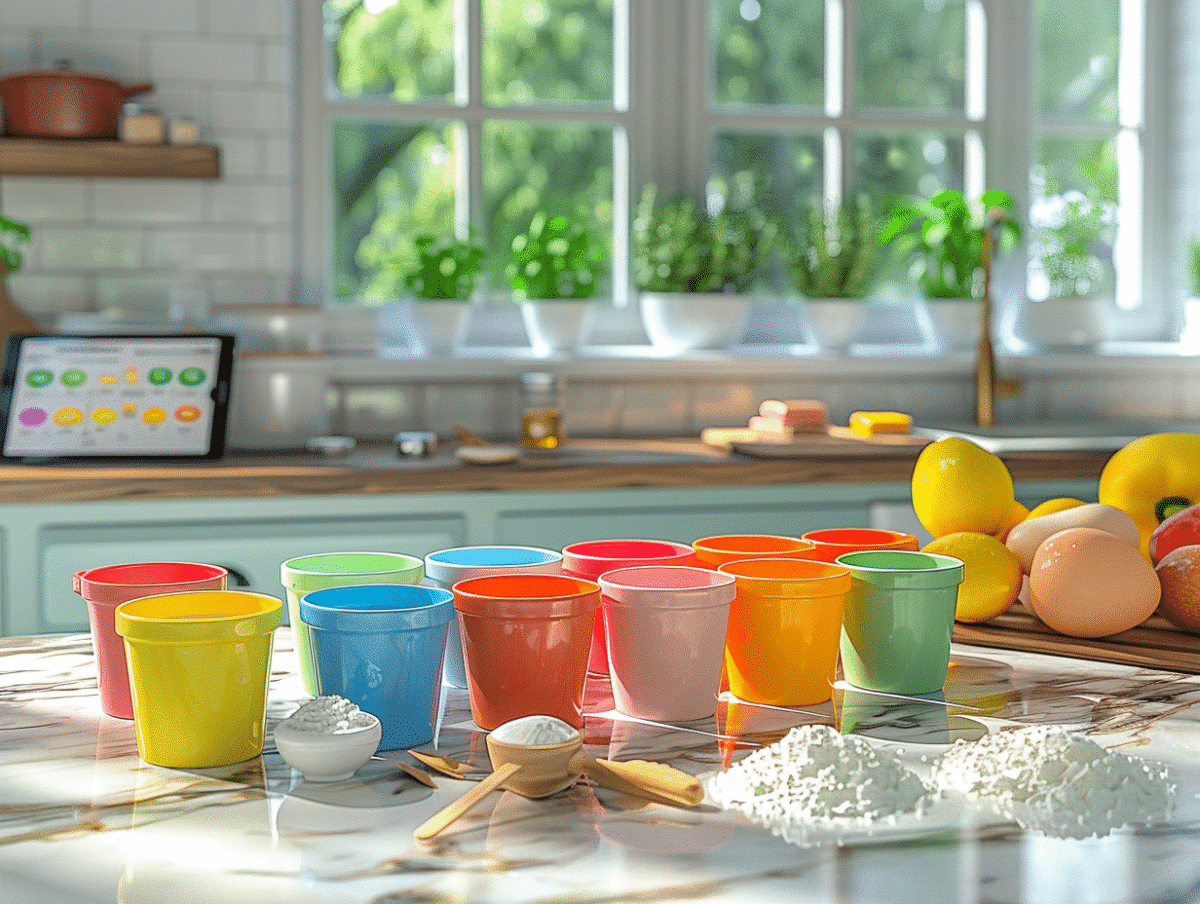
In the culinary world, the precision of measurements is essential to ensure the success of recipes. This is especially true when it comes to converting volumes, a task that can be complex due to the diversity of measurement units used around the world. To achieve accurate results, both amateur and professional cooks turn to various tips and online tools. These resources help simplify conversions, whether it’s converting milliliters to tablespoons or cups to liters, ensuring that each ingredient is measured accurately.
The Fundamentals of Volume Conversion in Cooking
Mastering measurement units is the first step towards successful volume conversions. In cooking, milliliters, grams, and centiliters are the most commonly used units. This triptych of measurement-volume-mass is essential for correctly interpreting recipes. Understanding that 200 ml in cl is equivalent to 20 centiliters allows for easy juggling between these measurements. It’s important to note that the density of the ingredient plays a key role in this conversion: while 1 ml of water corresponds exactly to 1 gram, this will not be the case for other substances like flour or milk.
The use of appropriate measuring instruments, such as a kitchen scale for mass and a measuring cup for volume, is fundamental. These devices ensure an accurate and reliable measurement, thus contributing to the precision of conversions. For standard liquids like water and milk, which have densities of 1 g/ml and slightly higher, the measuring cup provides a quick and effective indication. However, for more heterogeneous ingredients like flour or sugar, the kitchen scale becomes a valuable ally, allowing for precise measurements in grams, despite variations in density.
Understanding and correctly applying density principles is essential. Density, the ratio of mass to volume of an ingredient, is what allows for determining the appropriate conversion. Keep in mind that 200 ml of milk might weigh about 206 grams, while 200 ml of flour does not weigh 200 grams, due to the different densities of these ingredients compared to that of water. Therefore, the density of each ingredient directly influences the conversion of measurement units, and by extension, the accuracy of recipes.
The Best Online Tools for Accurate Conversion
In the digital realm, a plethora of online tools are dedicated to assisting cooks with volume conversions. Conversion charts, available on various websites, provide a quick overview of equivalences for a multitude of ingredients. These charts offer the equivalence between common measurement units and allow for easy conversion from milliliters to grams or vice versa. They prove to be valuable resources, especially when it comes to transposing measurements from one system of units to another, thus facilitating the understanding of foreign recipes.
Beyond static charts, mobile applications dedicated to culinary conversion are multiplying. They offer advanced features such as specific conversion for ingredients with variable densities. These applications, often intuitive, allow users to select the ingredient, enter the desired quantity, and obtain the equivalent measurement in their chosen unit. The accuracy of ingredient measurements is thus optimized, ensuring the success of culinary preparations.
We should not overlook specialized websites that, in addition to charts and applications, offer conversion methods and tips for accurate volume measurement. These educational platforms can guide users through the conversion process and provide tips for measuring accurately, even without a kitchen scale or measuring cup at hand. They are a wealth of information for cooking enthusiasts eager to achieve perfection in their culinary creations.