
You put your glasses on in the morning and take them off at night. In between, they sit on your nose for hours while you work, drive and eat. Choosing glasses that combine style and everyday comfort starts with finding a pair you eventually forget you’re wearing—without compromising the image you project.
The actual weight of glasses: why the frame alone doesn’t tell the whole story
Most product listings show the weight of the frame without lenses. You compare two models, choose the lighter one and think you’ve solved the comfort question. The problem arises once the lenses are fitted.
Your prescription can significantly affect the final weight. Thick lenses for severe myopia, or progressive lenses that require a certain frame height, change how the weight is distributed across your nose and ears. A frame that feels light on its own can become heavy once fitted, while a slightly denser frame made of titanium or thick acetate may sometimes distribute the weight better.
Before settling on a pair, you can compare two frames by asking your optician to estimate the weight of each fully fitted with your actual prescription. As explained in compression surgery explained by 123santemag.fr, this kind of check can help you avoid disappointment after your purchase.
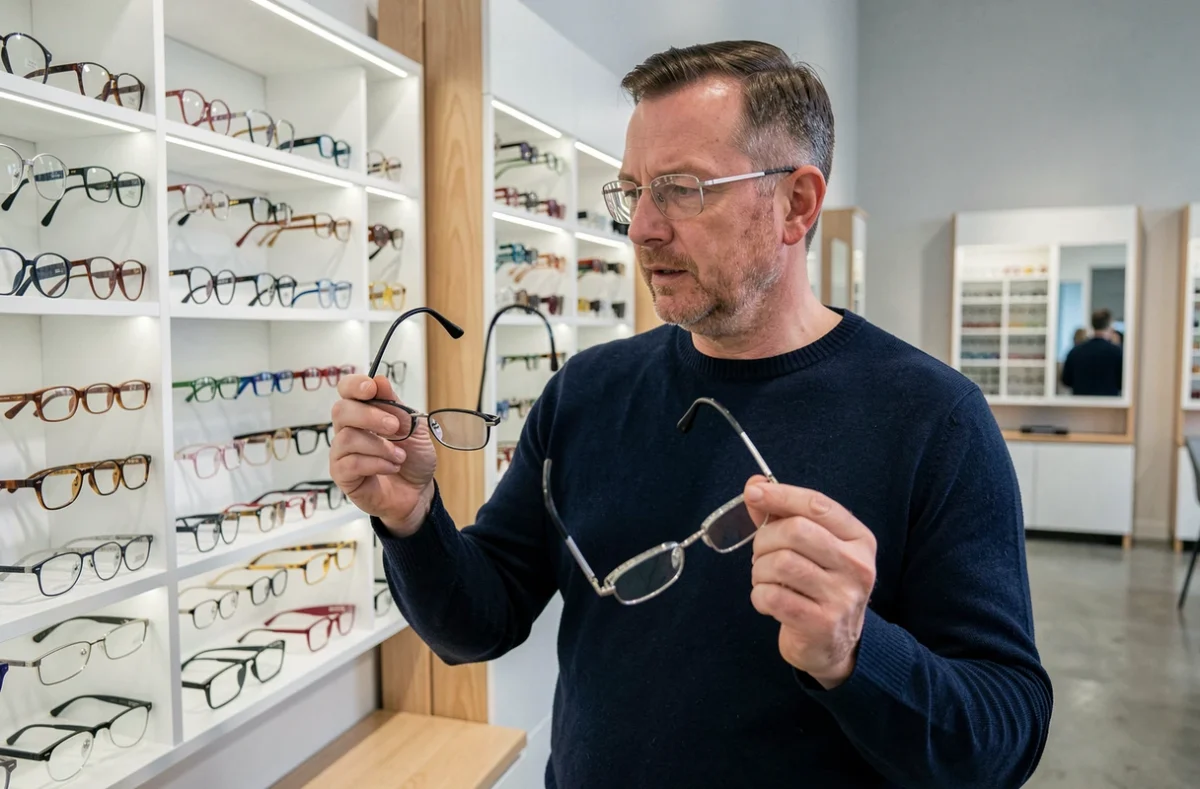
Frames and progressive lenses: technical requirements to check before you fall in love with a pair
People who wear progressive lenses face a limitation that online catalogues almost never mention. Progressive lenses need a minimum fitting height to give each of the three vision zones (distance, intermediate and near) enough space.
In practice, a frame that is too shallow compresses the transition zones. Your gaze shifts too quickly from one prescription to another, which can cause dizziness or blurred peripheral vision. A frame for progressive lenses needs enough usable height to allow accurate fitting without compromise.
Wraparound curves and rimless frames: two common pitfalls
Highly curved frames (wraparound or sporty styles) pose a second problem: the angle between the lens and your line of sight can distort the prescription, especially around the edges. Rimless frames can also make it harder to secure some prescription lenses because of their thickness at the mounting points.
Your optician should therefore confirm that your chosen frame is compatible with your prescription before ordering the lenses—not afterwards.
Fitting and adjustments: comfort matters after the purchase, too
You leave the store with glasses that seem perfect. Two weeks later, a red mark appears on the bridge of your nose, or the arms start pressing behind your ears by the end of the day. That doesn’t necessarily mean you chose the wrong frame.
Having the nose pads and arms professionally adjusted resolves most of these issues. Silicone nose pads can be repositioned to spread the pressure over a wider area. The arms can be gently bent to follow the shape of your head without squeezing your temples.
- Nose pads can be adjusted for width and angle to change how they rest on your nose and how high the frame sits in front of your eyes.
- The arms can be bent at the temple tips (behind the ears) to keep the glasses secure without excessive pressure.
- The overall tilt of the frame front (pantoscopic tilt) affects visual comfort, particularly with progressive lenses.
If discomfort persists despite several adjustments, take it as a sign: the frame may not suit your face shape or prescription. It’s better to reconsider your choice than to put up with an awkward compromise.
Frame materials: acetate, metal or titanium for everyday wear
The material affects how the frame feels against your skin, how durable it is and what styles are possible. The three main material families cover most everyday needs.
Cellulose acetate is still the most common choice for colourful or thick frames. It comes in a wide range of shades, including tortoiseshell and translucent finishes, and offers some flexibility. However, acetate can leave more noticeable marks on sensitive skin around the bridge of the nose if it isn’t fitted properly, as it rests directly on the nose without nose pads.
Metal (stainless steel or aluminium) allows for slim, understated frames, often with adjustable nose pads. It’s a good choice if you want a lightweight look and wear your glasses all day in front of a screen.
Titanium combines lightness, corrosion resistance and hypoallergenic properties. It costs more, but its durability can make up for the higher price over the frame’s lifetime.

Choose based on how you’ll use them most
For regular physical activity, frames made from polyamide (TR90) or Grilamid are more resistant to impact and sweat. For long periods of sedentary use (at a desk or reading), titanium or slim metal frames with adjustable nose pads offer greater lasting comfort.
Frame colours and style: what works beyond the trends
Trends come and go, but the best guide is still how well the frame works with your face. Frame colour is best chosen to complement your skin tone and hair colour, rather than the latest fashion.
Warm shades (tortoiseshell, gold, caramel) work best with warm skin undertones. Cool shades (black, silver, blue-grey) suit pink or olive undertones. Transparent or crystal frames sidestep the issue, offering a neutral look that works with every skin tone.
- Thick, colourful frames make a style statement but come with a trade-off: they become a prominent feature of your face.
- Slim metal frames are versatile and work just as well at the office as they do on a night out.
- Round frames soften angular features, while rectangular frames add definition to a face with softer curves.
The best test is to try them on in real-life conditions: wear the frames for a few minutes in front of a mirror and see how they feel when you talk, laugh or look down. If you keep pushing them back into place with your fingertip, they’re not the right pair, no matter how stylish they look.
Ultimately, the best frames are the ones you stop noticing after an hour of wear. You see the style in the mirror; you feel the comfort all day. Both deserve equal consideration when choosing a pair, and trying them on fully fitted—with the lenses in place and the frame adjusted—is what helps you make the right decision.