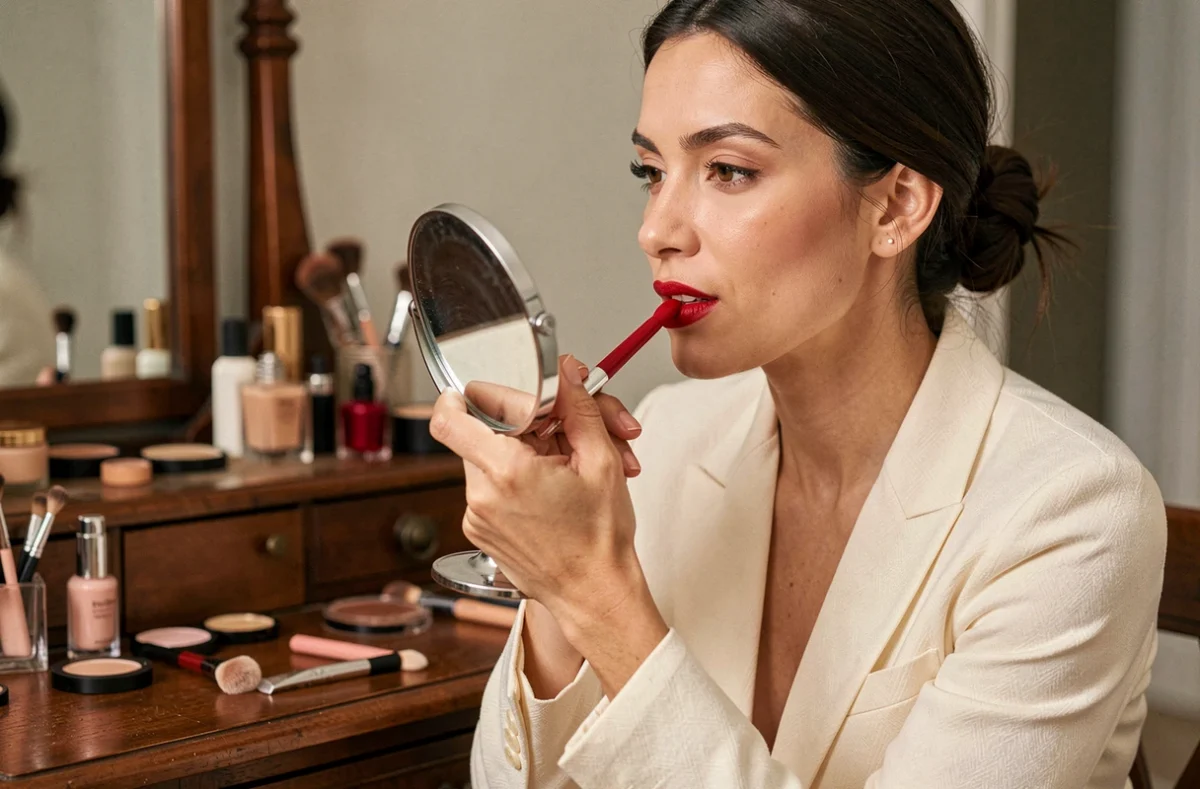
Red lipstick has been a subject of debate in psychological research for around fifteen years, but the findings are far from the consensus suggested by most mainstream articles. Understanding why red lipstick attracts men requires looking beyond evolutionary shortcuts and examining the evidence more rigorously.
Publication bias and the robustness of studies on the color red
Scientific research on red and attraction relies largely on laboratory protocols: men rate photos of women, sometimes digitally altered to change the color of their lips or clothing. Early publications reported clear effects, which the mainstream press repeated without qualification.
A 2018 meta-analysis combining published and unpublished findings, however, offered a more nuanced picture. The authors concluded that the average effect of red remains modest and noted signs of publication bias, particularly in studies of men’s ratings of women. In other words, studies with null or negative results were less likely to be published, artificially inflating the perceived effect.
Replications across multiple samples have not consistently reproduced the original effect. Caution is warranted: a preference that can sometimes be observed in a laboratory is not a universal rule. These protocols measure reactions to a static image, not attraction during a real-life encounter.
Several recent studies examine men’s attraction to red lipstick by distinguishing between laboratory settings and social interactions, which radically changes how the results are interpreted.

Facial contrast and visual salience: how lipstick is perceived
Before discussing seduction, it is important to consider visual perception. Red lipstick increases the luminance contrast between the lips and the surrounding skin. The human visual system detects this signal quickly because it draws attention to the mouth.
This phenomenon is not unique to red. Dark burgundy or bright pink also increase facial contrast. Bright red stands out because of its wavelength (around 700 nm), which the visual cortex processes preferentially in contexts of high color saturation. The practical result: the eye settles more quickly and for longer on lips made up in red than on bare lips or lips in neutral shades.
What facial contrast actually signals
Some studies link high facial contrast to perceptions of youth and femininity. Lip makeup accentuates an existing sexual dimorphism: women naturally have greater lip-to-skin contrast than men. Lipstick amplifies this signal, but that does not necessarily mean the observer experiences sexual attraction.
- Facial contrast acts as an amplifier of visual salience, not as an automatic trigger for desire.
- The effect varies with the lipstick wearer’s skin tone: an orange-red on fair skin does not create the same contrast as a blue-based red on dark skin.
- Context (lighting, distance, and the presence of other makeup) strongly influences how contrast is perceived.
The cultural dimension of lipstick and the construction of seduction
The association between red and seduction is culturally constructed, not biologically hardwired. Throughout Western history, lipstick has alternated between a marker of high social status (ancient Egypt, European courts), a sign of moral transgression (Victorian England), and a tool of women’s emancipation (American suffragettes).
This historical range of meanings shows that the significance of lipstick depends on the era and social context. Men do not react to lipstick in a cultural vacuum: their perceptions are shaped by learned codes, media representations, and local beauty standards.
The role of cinema and advertising in shaping perception
Hollywood cinema of the 1930s–1950s consistently associated red lips with desirable female characters. Repeated over decades, this visual association created a powerful cultural conditioning effect. Beauty advertising perpetuates the same pattern, presenting lipstick as a tool of seduction rather than simply an aesthetic choice.
This conditioning helps explain why the effect of lipstick on men’s perceptions varies from one culture to another. In settings where visible makeup is less socially valued, lipstick may elicit neutral or even negative reactions.

Lipstick and self-confidence: its effect on the wearer
One often-overlooked angle in discussions of attraction is that lipstick changes the wearer’s behavior before it changes the observer’s. Several qualitative surveys report that women who choose a bright red lipstick describe changes in their posture, eye contact, and confidence during social interactions.
This phenomenon, sometimes referred to as enclothed cognition applied to makeup, means that a cosmetic product can act as an internal cue for confidence. Men’s perceived attraction may therefore stem as much from the woman’s behavioral changes as from the color itself.
- Lipstick affects posture and body language, two factors in attraction that are more powerful than color alone.
- The confidence boost depends on a woman’s personal relationship with makeup: a woman who feels uncomfortable wearing bright red will not benefit from this behavioral boost.
- The social context (a date, a professional setting, or an outing with friends) determines whether lipstick strengthens or undermines perceived confidence.
The original question—why does red lipstick attract men?—deserves a layered answer. The perceptual effect of facial contrast exists, but remains modest. Cultural conditioning greatly amplifies the signal. And the behavioral changes in the person wearing the lipstick are probably the most underestimated factor in the equation.