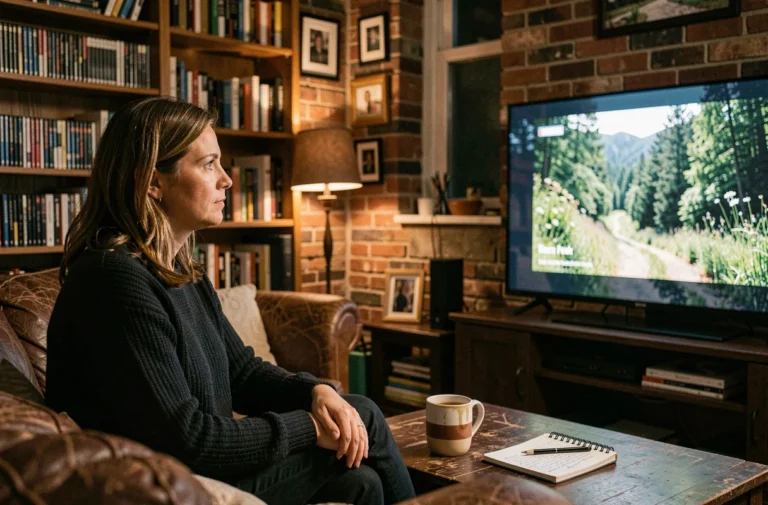
A colleague who has been dragging persistent fatigue for months ends up changing just one parameter of his day: he shifts his dinner by an hour and turns off his screens thirty minutes before going to bed. Three weeks later, his concentration at work improves and his lower back pain decreases. Improving daily well-being through health does not require a revolution in life, but rather identifying actions that have a measurable effect on the body and mind.
Evening screens and mental health: the underestimated lever
We often talk about sleep when discussing screens in the evening. The problem goes further. Recent studies link evening screen exposure not only to sleep degradation but also to an increased risk of depressive symptoms and unbalanced eating behaviors.
Specifically, it is observed that people who check their phones or look at a bright screen in the hour before bedtime take longer to fall asleep and report more nighttime awakenings. Turning off screens at least thirty minutes before bed remains the most directly applicable measure.
For those who find it difficult to quit, educational resources can be explored on the health section of Je Comprends Enfin, which addresses these mechanisms in an accessible way. The idea is not to demonize technology, but to set a clear time limit, just as one would with caffeine after a certain hour.

Social prescription: when the doctor recommends gardening instead of a pill
Since the end of the 2010s, several health systems (UK, Canada, Nordic countries) have been experimenting with the prescription of non-medical activities. The principle: a general practitioner directs a patient suffering from isolation or mild anxiety disorders to a walking group, a gardening workshop, or a collective cooking class.
This is not a gimmick. Social prescription reduces the consumption of routine care among the affected patients, according to feedback from British programs. In France, this approach is gaining ground, although it remains less structured than in Anglo-Saxon countries.
Non-medical activities accessible without a prescription
No need to wait for a prescription to test the principle. Here are activities that produce documented effects on stress and mood:
- Outdoor walking, even short, practiced regularly, affects blood pressure and anxiety. A daily outing of twenty to thirty minutes is enough to notice changes over a few weeks.
- Gardening, even on a balcony, combines gentle physical activity, exposure to natural light, and contact with the earth, a combination that promotes stress regulation.
- Group workshops (cooking, art, music) add a social dimension, a protective factor against depression that is often overlooked in favor of individual approaches.
Feedback varies on this point depending on profiles, but the common denominator remains regularity: an activity practiced two to three times a week produces more stable results than a one-off intense effort.
Mental load and cardiovascular health: the invisible risk factor
Mental load (simultaneous management of domestic, family, and professional tasks) is now recognized as a risk factor for mental and cardiovascular health, particularly among women. Public Health France and Inserm have published dedicated content on this subject in recent years.
Distributing tasks concretely reduces chronic stress much more effectively than an isolated meditation session. We are talking about concrete tools: shared lists, explicit delegation, negotiation within the couple or family. These are recommendations that are rarely found in classic well-being guides, which focus on individual relaxation without addressing collective organization.
Three reorganization gestures that lighten the load
- Keeping a visible and shared list of household tasks (on the refrigerator or via a common app) to make distribution transparent.
- Defining a weekly family coordination slot, even fifteen minutes, where everyone takes charge of their responsibilities for the week.
- Identifying tasks that can be eliminated or simplified: a simpler meal one night a week, spaced-out ironing, online shopping instead of in-store.
These adjustments are not spectacular. Their effect on levels of fatigue and irritability can be measured in a few weeks, especially when the person who bore the heaviest load sees a real redistribution.

Micro-recoveries throughout the day: better than a big evening session
Well-being is often associated with a long ritual: an hour of exercise, thirty minutes of meditation, a hot bath. In practice, it is the micro-recoveries spread throughout the day that stabilize energy and mood the best.
Some concrete examples: getting up from your chair every hour to walk for two minutes, taking three deep breaths before a meeting, stepping outside for natural light mid-morning. These short breaks prevent the accumulation of muscle tension and cortisol better than a compensatory session at the end of the day.
The often-overlooked point concerns natural light in the morning, which resets the circadian rhythm and improves sleep quality the following night. No equipment, subscription, or dedicated time is needed: a coffee break near a window or outside will do the trick.
Improving daily well-being does not rely on a list of generic good resolutions. It depends on a few targeted adjustments: setting a limit on screens in the evening, redistributing mental load in the household, integrating short breaks throughout the day rather than a single late effort. These are modest changes, but their cumulative effect on sleep, stress, and energy is felt quickly, provided one sticks to them over time.